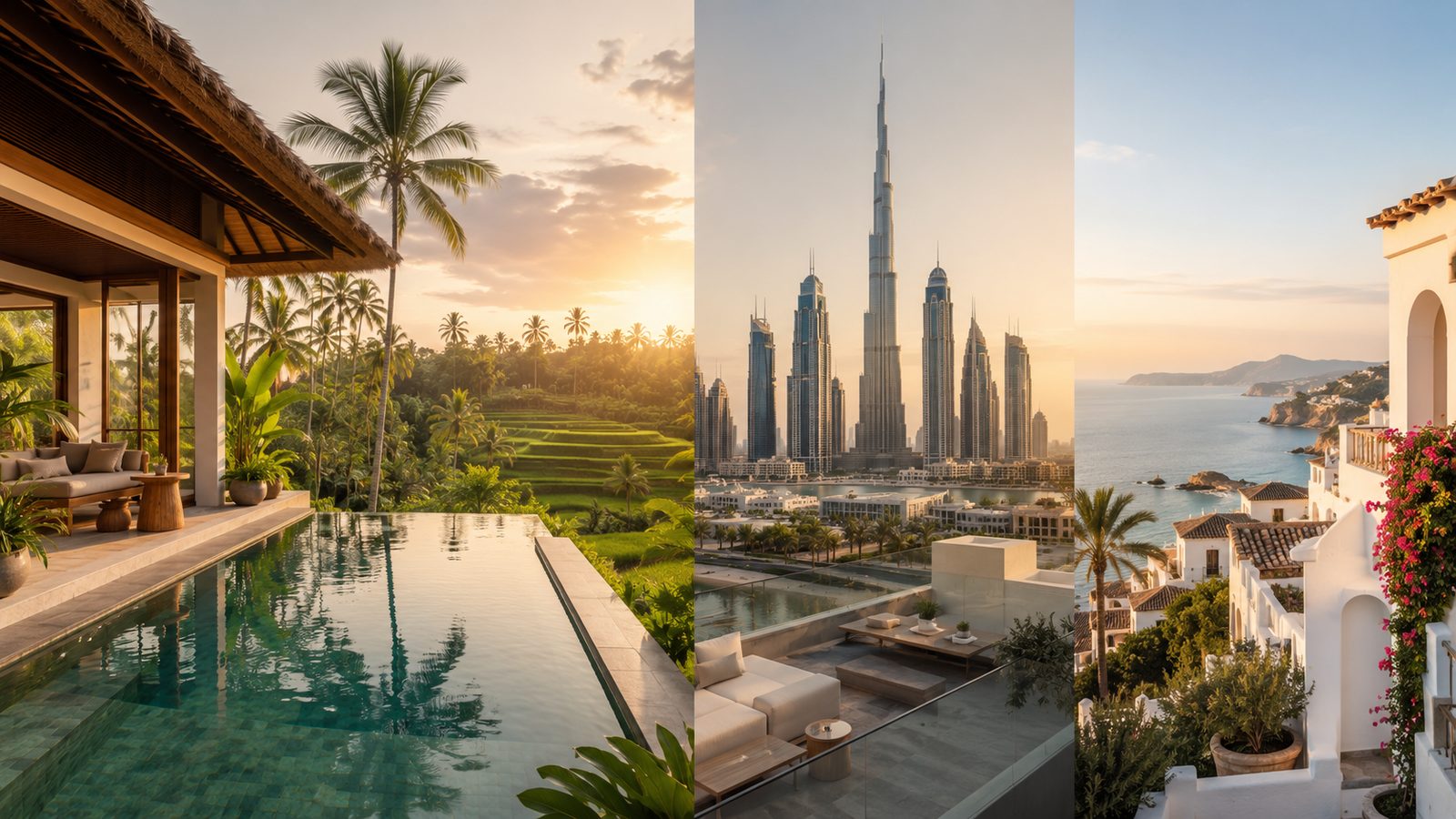
Investing in overseas property is always a trade-off between three things: yield, security and entry price. Few destinations offer all three at once. Bali is interesting precisely for how it resolves this triangle — and it's fair to say where it gives ground.
I won't tell you Bali is the best choice for everyone. For some, the security of European freehold is better, even at a lower yield. But if you care about cash flow and are willing to accept that this is an emerging market, the numbers speak clearly. Let's walk through them.
Yields: where the money is
Let's start with the main reason people head to Bali — rental yield. Here are approximate net annual short-term rental yields based on current market data:
The difference isn't cosmetic. A well-managed Bali villa can earn two to three times what an apartment in a mature Western city does. The reason is structural: Bali is one of the strongest Airbnb destinations in the world, with year-round tourism demand and a short-term villa rental culture the whole market is built around.
Watch the difference between gross and net yield. Marketing materials often quote tempting gross figures (15–20%+), but what actually stays with you after management, maintenance and fees is the net yield. The figures above are net — and Bali still leads.
Entry price: what you get for your money
The second big factor is how much property your capital buys at all. And here the gap may be even wider than on yields.
For the same money that buys a small apartment in suburban Sydney, in Bali you can build a complete architect-designed 2-bedroom villa with a private pool.
Villa entry prices in Bali start on the order of $150,000–$300,000 for a full villa. In London, Sydney or good parts of Spain, that's the price of a small apartment with no garden, no pool, and a lower yield. This accessibility is why Bali is within reach even for an investor whose budget wouldn't stretch to Europe — or who can buy more for the same money and diversify.
Rental regulation: where you're actually allowed
This factor is often overlooked until you hit it. In Europe, short-term rentals are increasingly restricted:
- Spain — in Barcelona, Palma de Mallorca and Madrid, short-term rental licences are capped or restricted. You may end up in long-term letting at a lower yield.
- Portugal — the former draw (the Golden Visa) has changed, property is often no longer a route to a visa, and regulation is increasing.
- Bali — in licensed tourism zones, short-term rental is fully permitted. Zoning rules apply, but in areas designated for tourism (where we build), the Airbnb model is legal and common.
Where Bali actually falls short
Now, straight up, what sellers would rather not tell you. Bali isn't without catches, and it would be unfair to hide them:
Europe offers freehold security (you own it forever) and liquidity (you sell faster). Bali won't give you that — you hold leasehold and a sale can take longer. And because it's an emerging market, the yield depends heavily on how well the villa is built and managed. A generic "copy-paste" villa in an oversaturated area can disappoint; a quality villa with professional management is the difference between "benchmark" and "waste of money".
If you want a property to own forever, sell quickly whenever you like, and don't mind a lower yield — Europe may be the better choice for you. Bali makes sense when you care about cash flow and are willing to accept a longer horizon and leasehold. It's not universally the better choice; it's the better choice for a specific goal.
What about property back home?
An honest comparison has to include the "zero option" — keeping money at home. Property in your own country has an undeniable advantage: you know the environment, the language, the law, and it's within reach. But net rental yields in most mature home markets typically sit in the low single digits — far from what a well-managed Bali villa offers. And for the price of a city apartment at home, in Bali you can acquire a villa that earns several times more.
So the question isn't "Bali vs. home" as a contest, but what you want from the investment: security and proximity, or yield and diversification outside your home economy.
How we see it
We're not impartial — we build villas in Bali, so take our word with a grain of salt. But that's exactly why we got into it: we saw the difference in the numbers with our own eyes. We have two completed and sold projects behind us, and we know the key isn't "Bali as such", but the specific villa, location and quality of management. That's what decides whether the yield materialises.
If you're weighing where to place capital and want to go through the actual numbers for your situation — no marketing fluff, and with the risks included — get in touch. We'll gladly show you how it works out in reality.
Read on: where the money actually flows in Bali · why professional capital is turning here