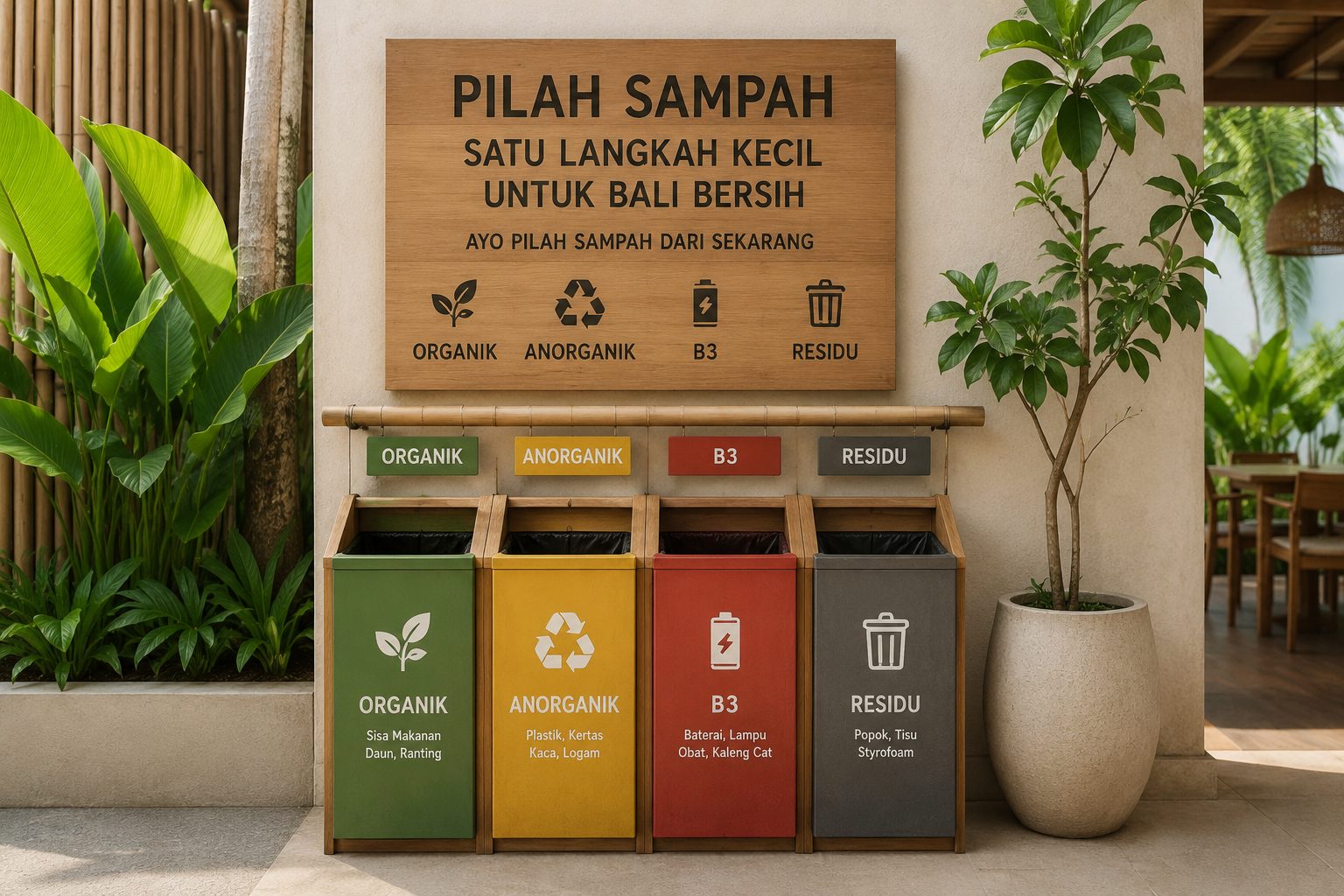
Bali has struggled with waste for years — growing tourism brought growing mountains of rubbish and overloaded landfills. In 2026, the island finally decided to do something fundamental about it. And because it also affects villa operations, it's a topic every investor should have on their radar.
What exactly is changing
From 1 July 2026, source-separation of waste is mandatory in Bali. The island has become a national pilot project for 100% sorting. The key points:
- Mandatory sorting for everyone — households, businesses, hotels, restaurants and private villas
- End of "mixed waste" — unsorted waste no longer has to be collected by services
- Organic waste banned from landfills (in effect since April 2026, due to methane and fires)
- Waste-to-energy — Bali's largest waste-to-energy facility is being built in Benoa (capacity 1,200 tonnes per day)
According to Bali's governor, earlier measures already led to over 87% of residents starting to sort their waste, and more than 100,000 composters were distributed. It's part of the ambition to make Bali the first tourist destination in Southeast Asia to truly achieve "zero waste to landfill".
Why it applies to your villa too
Here's the point that matters for an investor: the rules apply to rental villas as well. It isn't just a matter for local households.
In practice, for a commercially operated villa this means putting a working sorting system in place — either its own solution (such as a composter) or working with a licensed waste processor. For villa operations, waste handling is increasingly becoming part of the broader requirements for environmental compliance and operating permits. Put simply: waste is becoming a normal part of what a villa's operation needs to address. The specific requirements vary by location, though, so it's worth checking them with a local manager or advisor.
What it means for remote operation
If you own the villa from Europe, you might think: "more admin I have to handle from afar?" Not necessarily. Setting up a sorting system is exactly the kind of operational task handled by property management, not the owner. Colour-coded bins, staff training, a contract with a processor — the on-site manager takes care of it. You get a functioning villa, not an obligation to queue at an office.
For an owner with good management, the new rules aren't a burden — they're things the on-site team handles for you.
Why it's actually good news
It may sound like a complication, but from the standpoint of long-term property value it's a positive signal. For several reasons:
Higher-quality tourists and long-term tenants — precisely the segment premium villas target — increasingly seek eco-certified and sustainable properties. And in the bigger picture: a cleaner Bali means stronger tourism, which is the foundation of rental yield. Solving waste therefore protects what the value of every villa on the island rests on.
Straight up: it's not finished
To complete the picture — the transition isn't painless. The closure of the main Suwung landfill caused temporary collection problems; in some places waste piled up and the separate-collection system isn't fully in place everywhere. Experts point out that higher fines alone won't solve the problem and that a more comprehensive, locally adapted approach is needed. It's the right step, but a longer-term one — and when choosing a location and a manager, it's worth asking how waste handling is actually solved in that specific area.
How we see it
Sustainability isn't a marketing slogan for us but part of how we build — "European precision, Balinese soul" also means respect for the environment we build in. We see the new waste rules as a step in the right direction and as part of caring for the long-term value of the villas and for the island we make our home. At our projects in Tumbak Bayuh and in Nyanyi, waste handling is a natural part of operations.
If you're thinking about how your villa's operation would work in practice — including things like this — get in touch. We'll gladly describe, straight, everything we handle on the owner's behalf.